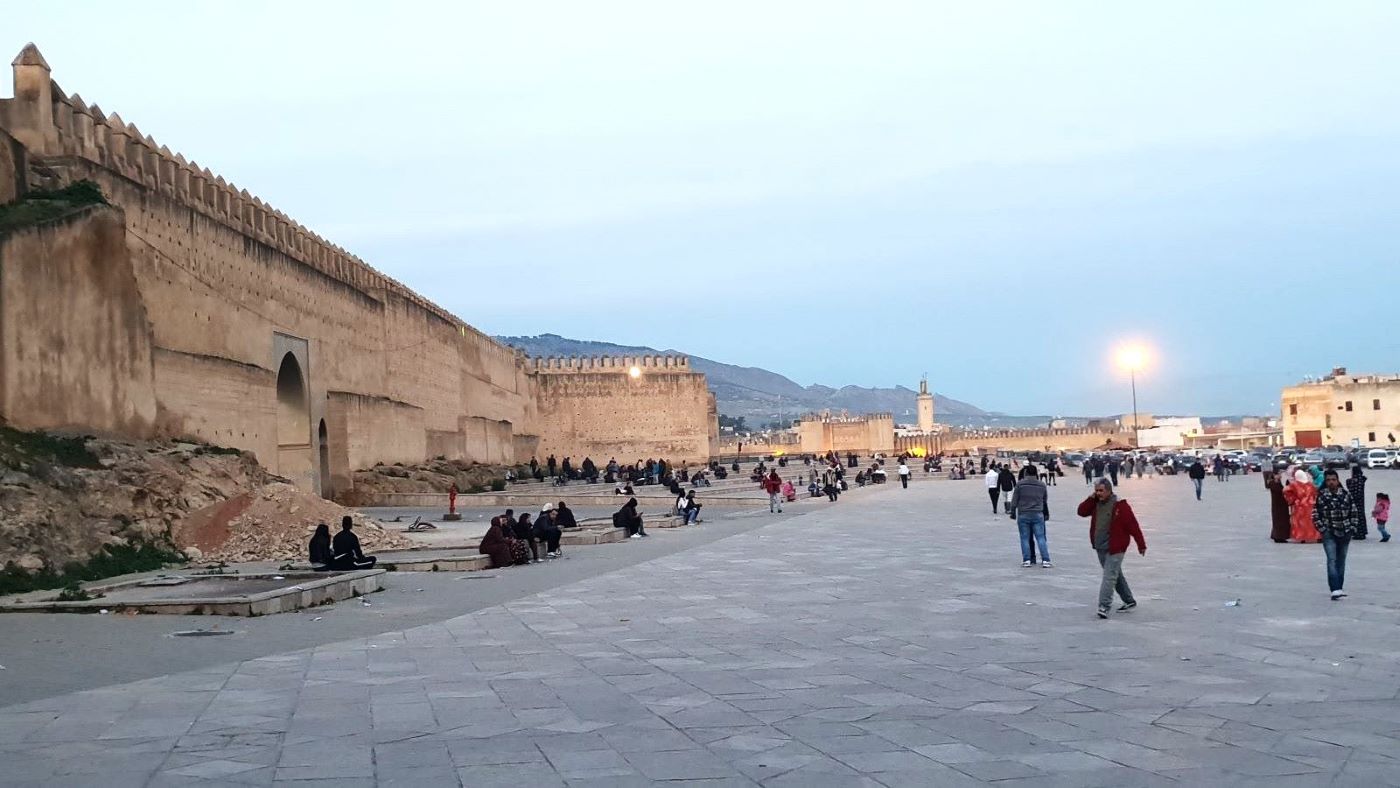
Morocco was our first visit to the African continent, and our last trip pre-Covid
With Mediterranean and Atlantic coasts, Morocco has a long history of trade and interaction with Europe. For the traveller, there is much to learn and discover in this fascinating country. At the Straits of Gibraltar, it’s less than 15 kms (about 9 miles) between Morocco and Spain. So close that there are regularly planned swimming events from one to the other. The short distance is one reason African refugees try to make their way from Morocco into Europe through the doorway of Spain.
Our sampling of Morocco did not allow us time to enjoy the Atlas Mountains, or to step off into the Sahara Desert – adventures for another time. We explored Morocco as independent travelers and hired a car to get around. Wherever possible we stayed in Riads, and in or close to the Medinas.
Parts of Morocco are green for 8 months of the year. We drove through rich agricultural country, starting with horses and ploughs in the north through to wide open farming fields and orchards laden with oranges and olives further south. The oranges are fantastic – perhaps the best we have tasted anywhere in the world. We were told that the economy of Morocco relies on agriculture, fishing, tourism (and cannabis). This Economic Update from the World Bank, issued in April 2021 notes the importance to the Moroccan economy, of agriculture (and the impact of drought) as well as the contraction in tourism as a result of the pandemic.
Just as you should before travelling to any new destination, check your country’s travel advice, be respectful of local culture and remain aware. You may be offered drugs – know that the penalties are severe. If in doubt about your travel arrangements, consider an organized tour that suits your needs.
Is there a simple, locally grown produce item that transports you back to where you tasted it? Oranges always remind us of Morocco.
The Blue City is truly blue, and beautiful. The blue arises from Chefchaouen’s history as a Jewish town. Now with an Islamic history as well, the blue has been perpetuated and draws hundreds of tourists to the town. Set on and around a hill, its narrow alley ways meander up and down and draw you past traders with wares in colours galore. Woven rugs, paint pigments, silk threads, laces and ribbons, spices, fresh fruit and vegetables, and of course the Argan Oil for which Morocco is famous. Hhere’s a link to find out more about Argan Oil on Wikipedia.
We visited Morocco in January, outside peak tourist season. Chefchaouen is one of Morocco’s top destinations so may be very busy during the summer months.
We loved Fez!
We stayed in a Riad, close to the gates of the Medina. A Riad is designed to look inward and typically is plain fronted building with a large timber door facing the street. Inside the rooms are arranged around a central courtyard which in past-times would have been open to the sky. In the centre of the courtyard there is usually a fountain which allows occupants to wash before prayers. Many Riads are family run and will provide a family cooked meal, often a typical Moroccan tagine. In Fez we had a delicious chicken, preserved lemon and olive tagine like this.
Exploring the Medina
We arranged a local English-speaking guide through the Riad-owning family. Very necessary! The Medina is a fantastic, chaotic, vibrant, intense trading city. Google Maps will not suffice to find your way around the labyrinthine alley ways and passages. It is a UNESCO World Heritage site. More on its history and cultural importance here, where the Medina is said to ‘not only represent(s) an outstanding architectural, archaeological and urban heritage, but also transmits a life style, skills and a culture that persist and are renewed despite the diverse effects of the evolving modern societies’. It’s pleasing to see restoration works including the ancient walls being repaired.
The Medina’s population is alternatively estimated at between 100,000 and 200,000 people, many living quite traditional lives. The only sources of transport within its narrow alleyways are hand drawn carts, or occasionally donkeys (sometimes rescuing exhausted tourists overcome by the intensity of the Medina!).
There are cultural sites throughout the Medina, and these offer a glimpse into the complex, changing history over hundreds of years. The Bou Inania Madrasa is an oasis of calm in the midst of the Medina. Architecturally elegant, it’s stone and timber carving, ceilings and tiles are overwhelmingly beautiful. Built between 1351 and 1357, not all the Madrasa is accessible, but what is, is well worth the small entry fee.
You may also be taken to a Caravanseri, where traders came to exchange their wares. The entry way will be large enough to accommodate camels heavily laden with goods. There are stalls around the bottom floor courtyard for animals and rooms for traders above. Some lovely examples of traditional woodwork, showcasing highly-skilled carpentry.
If you are looking for any sort of local hand-crafted goods, the Medina has it all. Agave silks, woven rugs, beaten copper pots, and of course leatherworks. The tanneries can be seen (and smelt) from above. Pots of different colour dyes range across open air workshops, as workmen move hides through the process. Wikipedia gives a bit more detail about Chouara Tannery, largest in Fez and believed to the oldest in the world.
As in Marrakesh, know that someone guiding you to a place or shop is likely doing it for money. This may be paid directly by you, or be a payment from the shop directly to the guide which you will not see.
Marrakesh is on every traveller’s itinerary for Morocco. Here we stayed in a Riad, deep in the Medina. There are no cars in the Medina, so our hosts met us and walked with us to our accommodation. Others were doing the same, perhaps loading up a donkey or hand cart with luggage. From the roof top of our Riad where breakfast was served, we could see the Atlas Mountains.
The Medina in Marrakesh is large, intense and chaotic to our Western eyes. Also inspiring, stimulating and pulsing with life. Jemaa el Fnaa square in the midst of the Medina has delicious night markets selling a wonderful array of food cooked there and then. Plenty of travellers around, but still genuine enough that there are locals eating too. Be wary about ‘special deal’ or ‘special price’ restaurants – we found they were likely to be rather more expensive than you could pay otherwise.
The Medina has more than 15 ‘souks’ specializing in different crafts. You are sure to find something to suit your tastes.
A bit about guides and traders – you will be approached by many ‘helpful’ men (we never met a woman doing this), wanting to guide you to wherever you are looking for. They will ask you for money. Alternatively, they will take you to a shop where they get a cut of any purchases.
If you wander into a shop, you will be warmly welcomed, offered mint tea and unable to escape a very persuasive sales pitch for whatever the store is selling. Even an official guide organised through your hotel will want to take you to particular shops. When they understand you understand what is going on, most will be good-natured and enjoy banter with you. But understand if you accept hospitality or engage in any way, you may find yourself buying a rug you never knew you wanted. Be polite, be clear and be firm – this is a way of life in a country trying to lift itself into a more prosperous future.
Marrakesh offers sites outside the Medina, including the ruins of the El Badi Palace built in the 1500’s. El Badi Palace is located close to the Medina and worth a visit to escape the intensity of the Medina. The Koutoubia Mosque built in the 12th century is the largest in Morocco and is also a short walk from the Medina (note that the interior of Mosques are not open to non-Muslims, however you can view the Mosque and its minaret from outside). Juxtaposed against the ancient history of Marrakesh is the Yves St Laurent museum which we did not have the opportunity to visit.
We visited Fez before Marrakesh and found Fez to have more charm and felt closer to experiencing historic Morocco than the more commercial, more westernized Marrakesh. What was your experience? Share your story and a photo with us at ideas@travelsampler.world